Until a few years ago, the most expensive part of a software idea was writing it. You had to put a team together, build for months and only then show it to a first user. Today that threshold has dropped to a weekend, sometimes a single day. Anyone who hands an AI tool a few screenshots of a product they like and a couple of sentences about what it does can have a working lookalike by the evening.
We see the result every day. Agencies and independent developers keep announcing new projects, some open source, some closed. Most of them are never updated again after the week they launch. They are not badly made. Making got easy, while owning something costs as much as it always did.
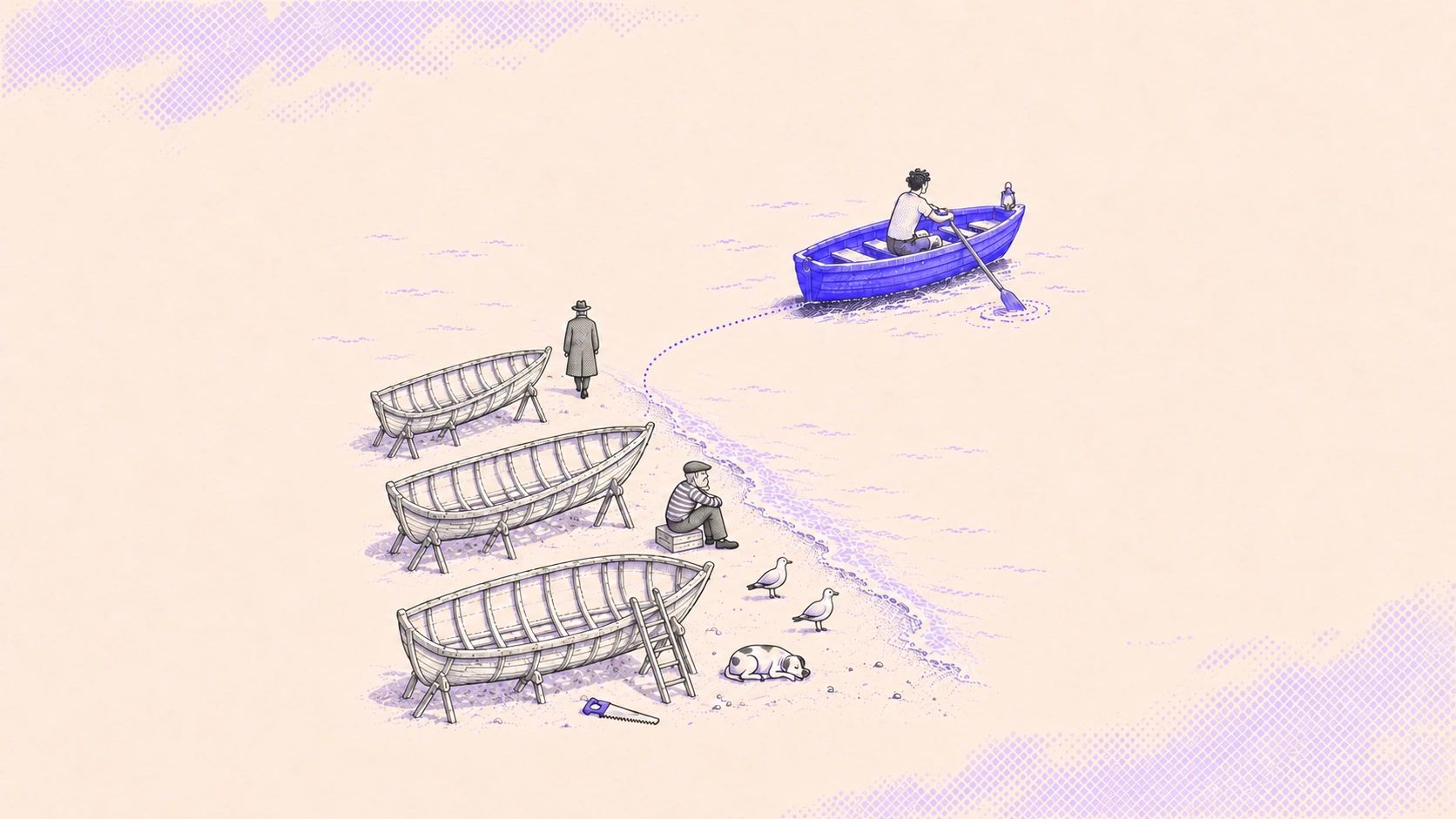
The software world today looks like a shipyard beach. The number of boats that put to sea, however, is not growing at the same pace.
A product was never just its code
AI lowered the cost of writing code. The rest of a product’s work is still there: answering a user who is stuck, adapting when a service you depend on changes, setting a price, sending invoices, founding a company, explaining what the product is to someone who has never heard of it.
Shipbuilders use the same word we do: the launch is the moment a hull slides down the slipway into the water. A launched hull is not yet a boat. Its engine, fittings and interior come afterwards, in a stage called fitting out. In software the launch got easier; fitting out is where it always was.
What these jobs have in common is that none of them is done once. A first version can ship in a day, but support happens every week, maintenance every month, and the brand is rebuilt with every post. Work that has to be repeated cannot be settled with a single prompt.
Then there is copyability itself. When everyone can make the same thing at the same speed, having made it stops setting you apart. What remains is the decisions inside the product and how long someone has stood behind them.
What happened at Fidkeep after the first version
Fidkeep is a SaaS product that helps businesses understand their customer feedback better. It brings reviews together in one place, prepares a reply to each in the business’s tone of voice and presents what stands out in monthly reports. Its first working name was Reply Pilot. The first version, built to test the idea, took a week or two and had few of today’s features; it read a review and wrote a reply. With today’s tools, another team could have reached the same starting point in the same time; it was one of the hulls on the beach.
The brand name had to grow with the product
Reply Pilot described only one of the product’s jobs: replying. As the product expanded towards comparing locations and reporting, the name became too narrow. Fidkeep brings together feedback and the act of keeping it.
Branding and investment for startups
In a startup, branding usually waits on the “once the product takes off” list. In How is a browser worth $610 million? we argued that a product’s value has less to do with code than with how a company talks to its users. At Fidkeep we saw the same thing in our own product, this time on the investment side.
A pre-seed deck was prepared while Fidkeep was still a product without a legal entity. The deck showed three things: a working application rather than a mockup, the problem it solves, and the subscription model, meaning plans, location and usage limits, and prices. What the investor saw was not a code repository. It was a product with a name and an identity, one that could explain whose problem it solves and how it will earn revenue.
Through that deck, a pre-seed investment was made in exchange for 31.76% of the product. The company was founded once the ownership structure had been set this way.
Explaining the product is part of the product
The first version was not a product. It was a single screen that read a review and wrote a reply; there was no team to use it, no plan to buy and no page explaining what it was for.
Most of the work that turned it into a product happened outside the code. Positioning came first: Fidkeep would be presented not as a tool that replies to reviews, but as a product that shows a business what it learns from them. The brand name, logo and identity were redone to follow that decision. The website, customer deck, social media and promotional films were then prepared with the same identity.
The programmes that support Fidkeep
Fidkeep was accepted into Anthropic for Startups, NVIDIA Inception and AWS Activate, and is now a startup supported by all three.


None of the items on this list were in the first two weeks of code. All of it was done after the hull existed, during fitting out. We told the design side of the story on the Fidkeep project page.
What we ask before starting a new project
Trying an idea has never been this cheap, and that is a good thing. Some answers can only be found by making; there is no reason to stop experimenting. The problem is announcing an experiment as a product and then leaving it behind. To tell the two apart, we ask ourselves a few questions:
- Who will look after this project in its second month?
- When a user runs into a problem, who will they write to and how soon will they hear back?
- Will the brand name still carry the product once it grows?
- Is there a structure to explain it, sell it and invoice for it?
- If someone builds the same thing tomorrow, what do we still have?
If most of the answers are “we don’t know”, what we have is an experiment. Calling it one is a relief for us and for the user. If the answers are clear, the work is only beginning.
The starting line is in the same place for everyone
AI has made reaching the first version of a piece of software nearly equal for everyone. That is why a first version now says very little about a product. Its sixth month says more: is it still being updated, does it answer its users, are its name and its language its own. Seen from the beach, the question comes down to this: is the boat still at sea?
What is written in a day can be written by someone else the next day. Anyone who wants to copy a product that has been owned again every week for months has to spend those same months.
How was this post?