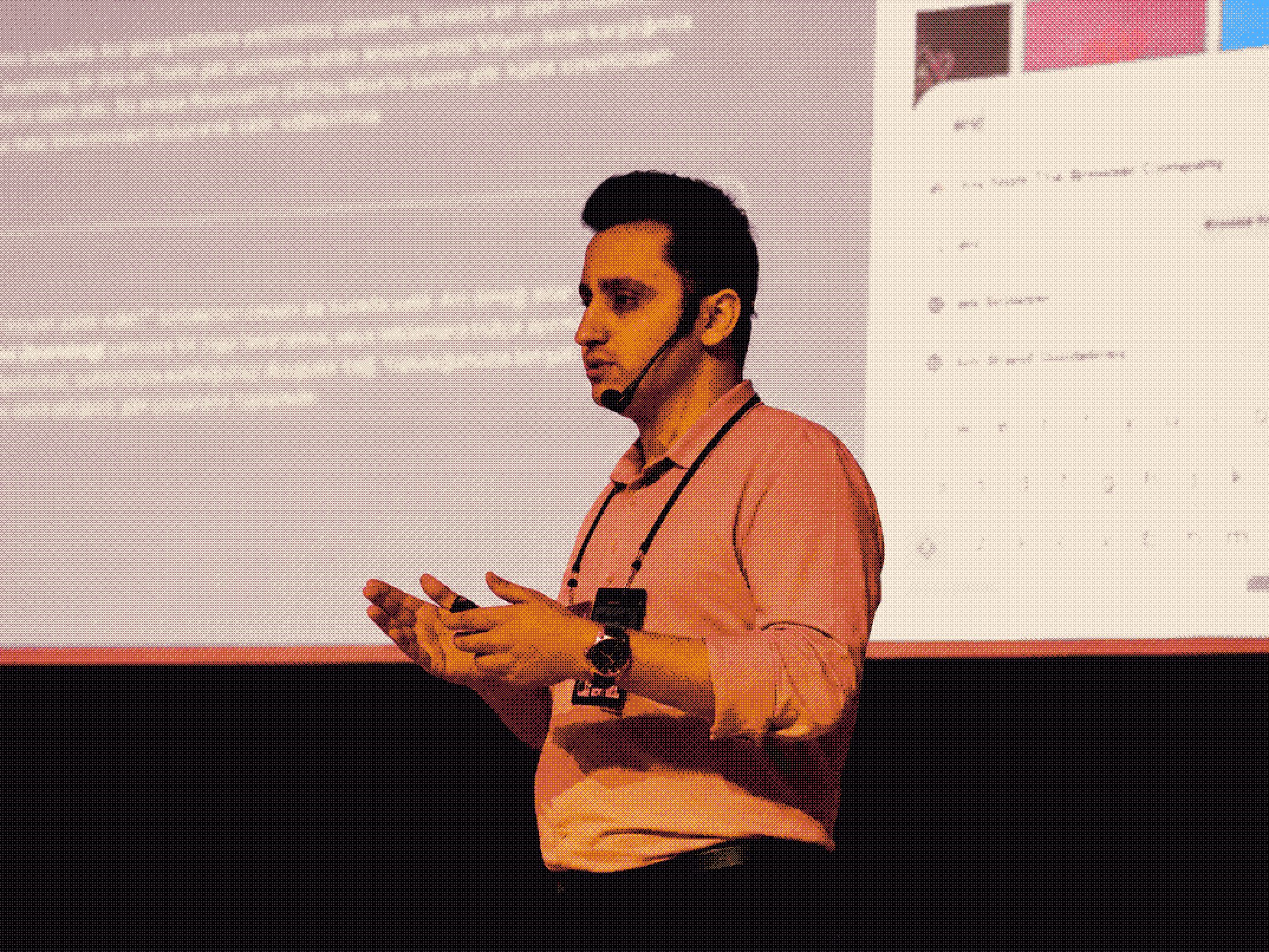
At GDG DevFest ’25 Gaziantep I gave a talk titled “How Is a Browser Worth $610 Million? Branding for Startups”. Most of the room were developers, and the talk’s real question was for them: if building a good product were enough, why do some products become far more valuable than similar ones?
I answered it through a browser I have used every day for four years. This post summarises the talk, with a small demo in the middle where you can try its main idea yourself.
A different browser in a settled category
Technology has always excited me; I follow Product Hunt and daily.dev closely and keep looking for alternatives to the tools I use. About four years ago, while it was still in alpha, Arc caught my attention. Developed by The Browser Company, Arc was technically a Chromium-based browser, yet it brought an unusually creative experience to a long-settled, rather static category.
As someone working on several projects at once, Spaces, the vertical layout that keeps tab chaos away, split view and the command bar genuinely changed how I work. I have used Arc actively since the day I first tried it.
But I did not go deep into Arc’s features in the talk. What I wanted to talk about was something we developers often skip. A rather “nerdy” team building its own interface on top of Chromium, and its CEO, did not skip it: the brand.
Like a friend, not a corporation
The Browser Company’s launch videos, its relationship with its community, even the design of the changelog it published every Thursday were part of its brand strategy. The videos were deliberately not too polished; they were edited to feel a little “amateur”, as if a friend on the team were telling you the latest news. That approach made users feel part of how the product was being built.
The same voice was everywhere: in the logo, in the identity, in an ordinary update announcement and in the personal member cards given to users. Mine says “Methodical Guide” under my name. It looks like a small detail, but it shows how carefully the relationship between a product and its users was thought through.
You notice the value of that consistency best when it breaks. In the demo below you announce the same update of a fictional browser on three surfaces. Change the voice of each surface and see what happens when the brand speaks differently in just one place.
Interactive
One announcement, two voices
By default the changelog and the video speak like a friend, while the member card has stayed corporate. Change the voice of each surface, or all at once; the verdict underneath tells you whether the brand still sounds like one person everywhere.
Liman · Version 2.4
A small browser. This release lets you group tabs by project.
The product and copy are fictional.
Changelog
Out of lineRelease Notes: Version 2.4
We are pleased to announce to our users the availability of the tab grouping feature. With this update, tabs can be grouped on a per-project basis and groups can be viewed in the vertical sidebar. Performance improvements and bug fixes have been implemented.
Your tabs now live in projects
We got tired of hunting for yesterday's spreadsheet among forty tabs too. Now you can group your tabs by project, and each group sits in the sidebar under its own name. We also fixed the freeze when uploading files. Sorry that took a while.
Who's talking: the companysomeone on the team
Launch video
Out of lineVoiceoverDDeniz, from the Liman teamMaximize your productivity with Liman 2.4.
Hi, I'm Deniz. Last month I was working with 63 tabs open, so we built this.
Liman · 2 days ago
Liman 2.4 Launch | Advanced Tab Management
We stopped working with 63 tabs
Who's talking: the companysomeone on the team
Member card
Out of lineLiman CommunityNo. 0417
Selin Aksoy
Standard Member
Here since the beta
Thank you for your participation in the Liman Community Program.
You were one of the first to ask for tab groups. Part of this release is yours.
Since March 2024
Who's talking: the companysomeone on the team
The member card sounds corporate; the other two sound like a friend.
Switch each surface's voice on its own. When even one of them talks differently, people meet two separate brands.
This interactive example isn’t part of the printed version; try it in the online version of this page.
A $610 million brand
Arc never reached a mass audience, and it was free. Even so, on 4 September 2025 Atlassian, the company behind Jira and Trello, announced it would acquire The Browser Company for $610 million in cash. The interesting part: Atlassian’s CEO Mike Cannon-Brookes was one of Arc’s first users and had contributed for years with bug reports and feature requests.
The acquisition
- Cash price
- $610M
- What Atlassian paid for The Browser Company.
- Browsers
- 2
- The deal covers both of the company’s products: Arc and the AI-focused Dia.
It would be unfair to credit the deal to the brand alone; the team’s product skill and its new browser, Dia, are part of that value too. But it is no coincidence that the person who could become the company’s biggest customer first became attached to the product as an ordinary user. A brand that brings its users into the process builds its most valuable relationships that way.
That is where the answer to “How is a browser worth $610 million?” lies. Branding is not just designing a logo or setting aside an ad budget. It is the sum of your product vision, the emotional bond you build with users, the way you talk to your community and how far you let them into the process.
What can a startup take from this?
These are the questions I left the room with at the end of the talk:
- Who is speaking? Are your announcements written by a company, or by someone on your team?
- Are the boring surfaces part of the brand? Do the changelog, error messages and invoice emails carry the product’s voice too?
- Where is the user in the process? Are bug reporters, early users and community members visible anywhere?
- Does every surface sound like the same person? Is there a gap anywhere between the logo and the release notes?
- Is it right for you? Are you making what the market or a blog post recommends, or a genuine expression of your team?
How was this post?